Xul Solar
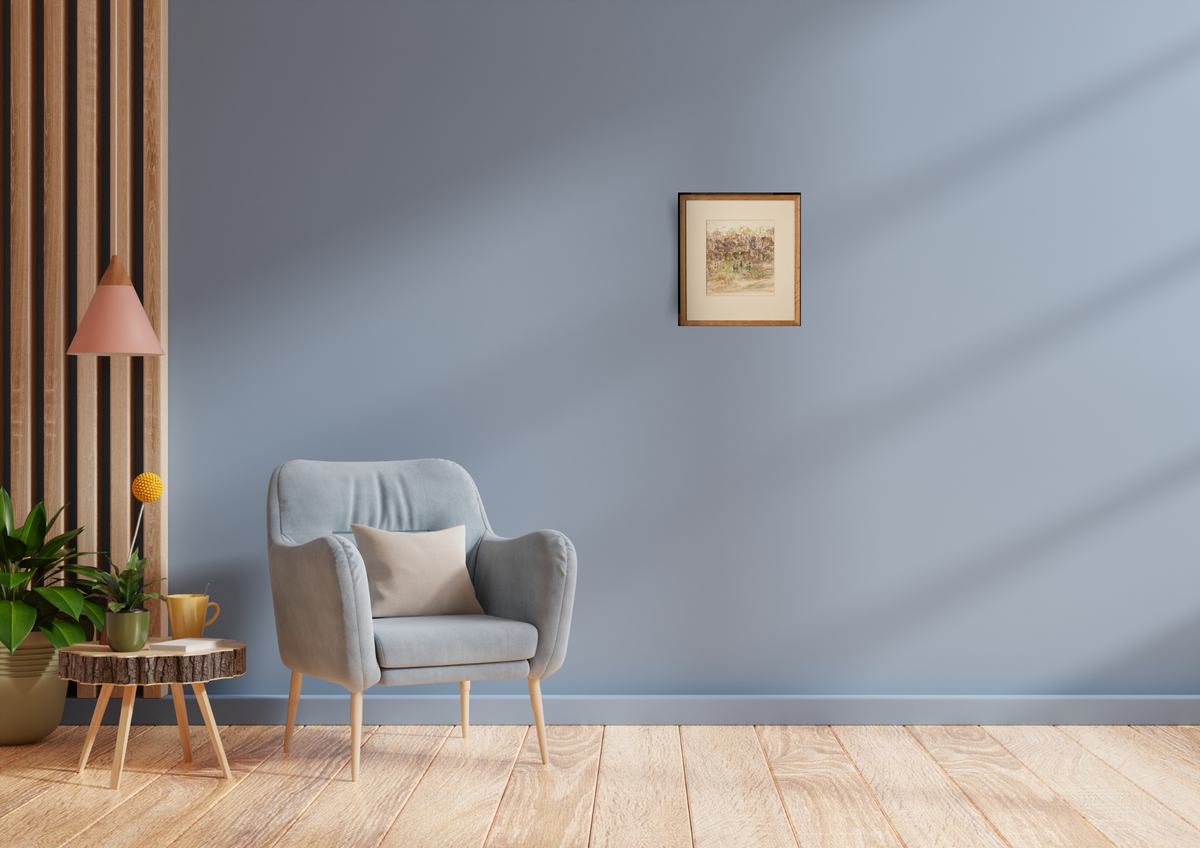
Urban Village Landscape with Trees and Figures
Urban Village Landscape with Trees and Figures
Couldn't load pickup availability
 Date Created 1929
 Size with Frame Height: 16 in (40.64 cm)Width: 15 in (38.1 cm)Depth: 1 in (2.54 cm)


This picture is sold as ' circle of ' Xul Solar. This captivating, whimsical work presents a densely clustered hillside town executed in the artist’s signature avant-garde, neo-primitive style. The upper two-thirds of the composition features a labyrinthine village of tightly overlapping, geometric houses. The structures are rendered in an earthly yet varied palette of muted browns, ochres, greens, and soft pinks, punctuated by tiny windows, pitched roofs, and chimney stacks. The buildings are outlined with delicate, expressive ink lines that lend the structures an organic, almost breathing quality. In the foreground, a expansive grassy meadow or public square slopes toward the viewer. Scattered across the field are stylized, simplified human figures wearing dark coats and brimmed hats, walking in small groups or pairs. The fluid, transparent watercolor washes and gestural pencil markings capture a sense of quiet community life, while a few minimalist birds soar in the sky above. This picture is signed and dated 1929. I have included a biography of the artist Xul Solar. Alejandro Xul Solar (born Oscar Agustín Alejandro Schulz Solari) was an Argentine painter, sculptor, writer, and inventor. He was one of the most enigmatic figures of the 20th-century Latin American avant-garde. His close friend, the legendary author Jorge Luis Borges, famously called him "a man capable of spaces" and "one of the most singular events of our era". Xul Solar did not just paint worlds; he spent his entire life inventing them. He combined a unique vocabulary of spiritualism, linguistics, and mathematical architecture into a highly idiosyncratic visual style. Born on December 14, 1887, in San Fernando, Buenos Aires Province. His father was a Baltic German immigrant from Latvia, and his mother was Italian. He initially studied music and spent two years studying architecture at the University of Buenos Aires. He dropped out to pursue broader intellectual interests. In 1912, he boarded a freight ship to work his way to Europe, where he stayed for twelve years traveling through England, France, Germany, and Italy. In 1916, he officially adopted the pseudonym Xul Solar. "Solar" honored his mother’s surname, while "Xul" reversed the Latin word lux (light)—meaning "Light of the Sun". While traveling Europe during World War I, he was heavily influenced by German Expressionism, Paul Klee, and the Italian Futurists. He also grew deeply connected to esoteric thought, mysticism, and astrology. Xul Solar returned to Buenos Aires in 1924. He quickly integrated into the radical Martín Fierro group (also known as the Florida group), an intellectual movement looking to throw out conservative academicism. His paintings from the 1920s to the 1940s became iconic. Rather than working on massive canvases, Solar preferred painting detailed, jewel-like watercolors and tempera on small cardboards. His artwork from this period frequently depicts pre-Columbian step pyramids mixed with floating geometric cities, mechanical flying vessels, and celestial staircases (Vuel Villa, 1936). Flag-waving structures, numeric codes, astrological glyphs, and religious references spanning Kabbalah, Buddhism, and Egyptian mythology. Xul Solar rejected the label of just being a painter; he viewed himself as a multi-disciplinary cosmic thinker. He invented Neo-Criollo, a poetic fusion of Spanish and Portuguese designed to unite Latin America. He also built Pan-Lingua, a universal language based entirely on mathematics, astrology, and musical tones. He fundamentally modified traditional chess into a three-dimensional game played on a modified board. Moves did not just serve a strategic role; they also corresponded to vowels, consonants, and astrological elements, allowing players to compose poetry while playing. He re-engineered traditional acoustic pianos, altering the keys and adding rows of color-coded keys to bridge the gap between sound and visual palette. In his twilight years, Xul Solar moved away from bright, crowded utopias. His work shifted to a series of monochrome drawings and calligraphic landscapes called Grafías (scriptures). He moved to a peaceful house in the riverside town of Tigre, Argentina, where he spent his time calculating astrological charts and translating texts. In 1962, a year before his death, he enjoyed a major triumphant retrospective exhibition at the Musée National d'Art Moderne in Paris. He passed away on April 9, 1963, at the age of 75. Today, his home studio in Buenos Aires serves as the Fundación Pan Klub (Museo Xul Solar), which preserves his artwork, personal library, custom chessboards, and modified pianos. His work continues to be celebrated globally as a unique, fantastical bridge between European modernism and Latin American magical realism.