Christopher Pemberton
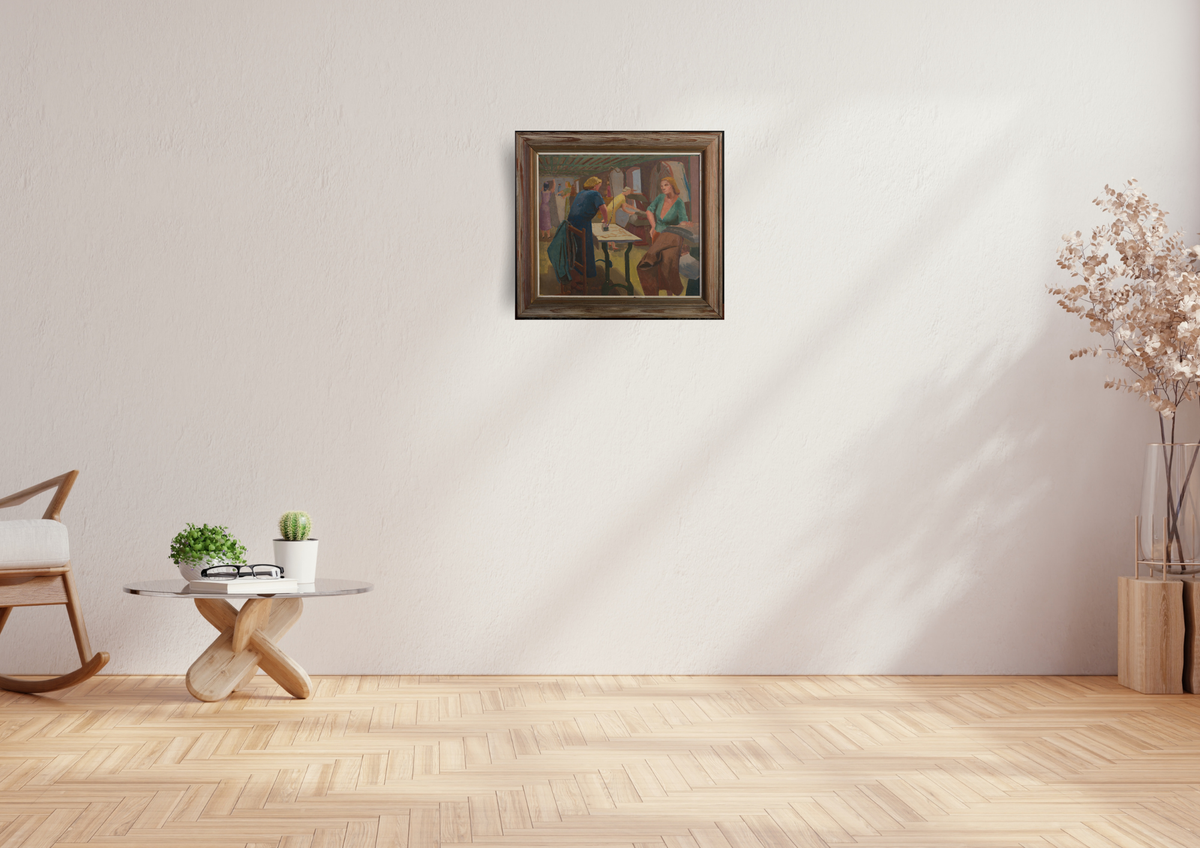
The Ironing Room
The Ironing Room
Couldn't load pickup availability
 Date Created Late 1940's
 Size with Frame Height: 18 in (45.72 cm)Width: 20 in (50.8 cm)Depth: 1.5 in (3.81 cm)


Christopher Pemberton 1923 -2010, was an English painter, draughtsman and teacher at the Camberwell School of Art. He was a student at the school and later became a teacher of art, he was influenced by William Coldstream and the Euston Road School, within the composition he would use fellow students and family members as the subjects. It is certainly a Camberwell School technique of painting a common feature is the tiny measurement marks which are very small vertical or horizontal dashes throughout the picture, the setting is typical of the late 1940's and early 1950's London factory workshop or Laundry, a popular subject in todays market unlike most businesses presently seated at a computer screen, this depicts a forgotten age of manual labour. The painting retains initials to the lower left, however we have catalogued the painting as unsigned. I have included a short biography of the artist for your interest. Christopher Pemberton (1923–2010): Christopher Henry Pemberton was a distinguished British painter, draughtsman, and educator whose career was deeply intertwined with the Camberwell School of Art and the rigorous tradition of objective abstraction pioneered by the Euston Road School. Born in Chelsea, London, Pemberton was the eldest of three sons. He was educated at Eton College, where he first began painting under the tutelage of Robin Darwin (later Principal of the Royal College of Art). During this period, he showed exceptional talent as a draughtsman, notably painting a significant mural of "The Meeting of Solomon and Sheba" Following service in the Royal Naval Volunteer Reserve during World War II (1942–1946), primarily on Atlantic convoys, he resumed his studies at Christ Church, Oxford, graduating with a degree in Modern History in 1948. Despite his academic background, Pemberton was determined to pursue a career as a professional artist. Pemberton entered the Camberwell School of Arts and Crafts in 1948 for a formative four-term period. At Camberwell, he was a pupil of William Coldstream and Claude Rogers, founding members of the Euston Road School. This influence was indelible; he adopted their disciplined, analytical approach to visual study, which emphasized measuring and close observation from life. Pemberton balanced a significant teaching career with his private practice, a common dual path for post-war British artists. 1950s: Taught at Bryanston School (Dorset) and Shrewsbury School (Shropshire). 1959–1984: Returned to Camberwell, where he taught for 27 years. He eventually served as Head of Foundation Studies until his retirement. His teaching was highly regarded for maintaining Camberwell’s reputation for the central importance of drawing. Notable students and colleagues during this time included Euan Uglow, Patrick George, and Anthony Eyton. Pemberton’s work spanned portraits, landscapes, and still lifes. His style is characterized by a "distilled product of many years of assiduous research," weaving pencil and brush through space to find "essential structure" from a state of flux. While he exhibited throughout his life—including at the Royal Academy (1956–1967) and the Hayward Annual (1982)—it was in retirement in Suffolk and during annual visits to his holiday home in Normandy that he dedicated himself to painting full-time. His landscapes of these regions are considered among his finest achievements. An artist with a scholarly mind, Pemberton translated Joachim Gasquet's Cézanne: A Memoir with Conversations (published by Thames & Hudson in 1991), demonstrating a profound understanding of Cézanne's influence on modern figuration. He also contributed to major art historical texts on the Camberwell School and the Euston Road School. He died in West Sussex in 2010. His artistic legacy continues through his extensive body of work and his son, Alexander Pemberton, who also became a professional painter. This picture is unsigned.