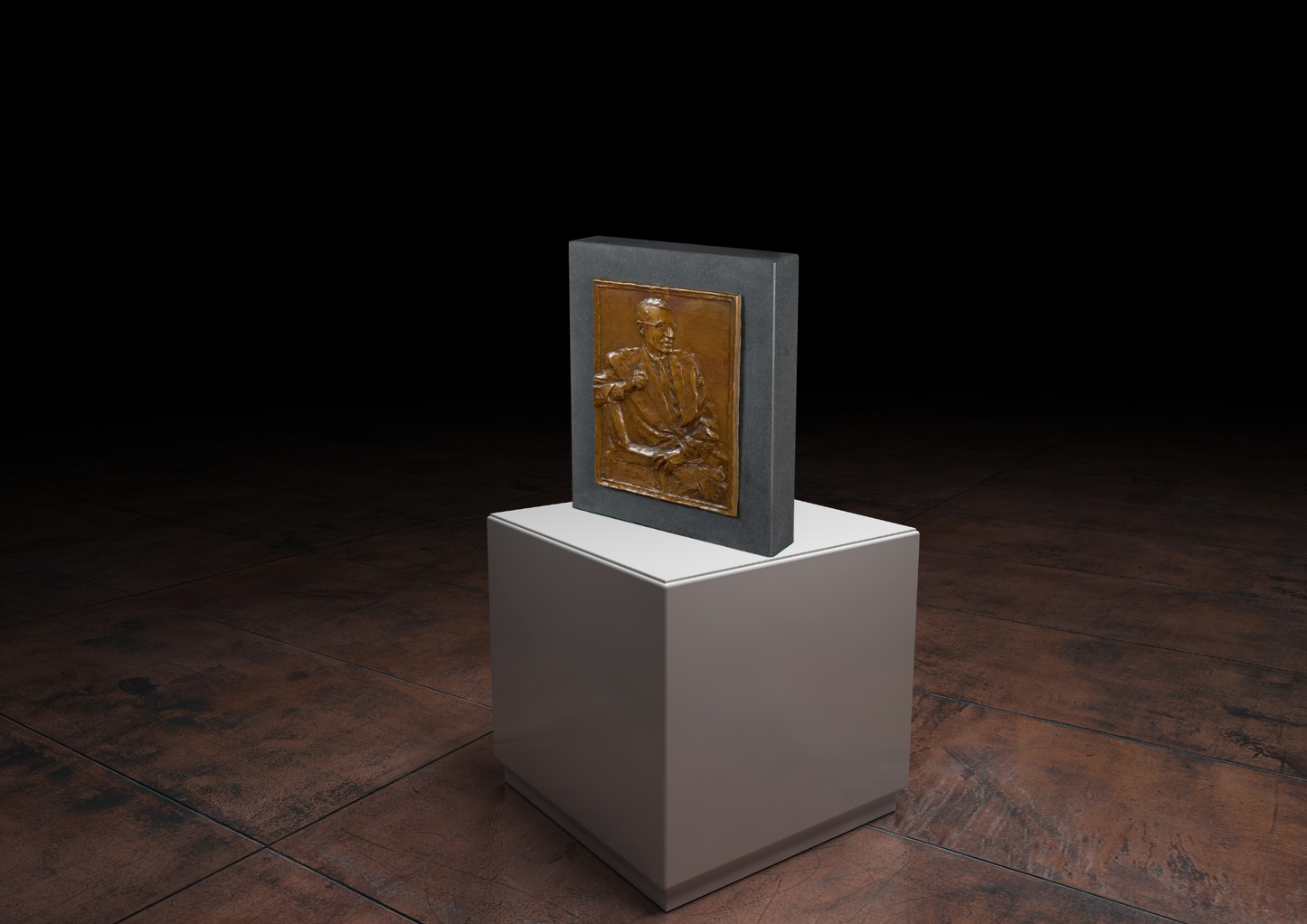
Arthur Miller
Robert Winthrop White
Robert Winthrop White
Couldn't load pickup availability
 Date Created 1950's
 Size with Frame Height: 12.75 in (32.39 cm)Width: 9.5 in (24.13 cm)Depth: 3.25 in (8.26 cm)


Robert Winthrop White 1921-2002, was an American sculptor who lived most of his life in New York. He was the grandson of the architect Stanford White and his great grandfather was the Shakespearean Scholar Richard Grant White. Robert White was brought up surrounded with a glittering family history of achievement and wealthy connections, he sculpted a substantial amount of work among which included the statue of General John J. Pershing and his clients included Harpers Magazine and a number of high profile personages. We are led to believe this portrait was created in the 1950's the date is unknown, however White signed the work, which was discovered in England, the extended family was of English ancestry, and as a plaque we decided to add a granite support to give it a greater presence. The granite support size is 16.5 inches x 13.5 inches and the total weight including the bronze is heavy at 76 lbs. This item needs professional packing and shipping. I have included a short further biography of the artist for your interest. Robert Winthrop White (1921–2002) was an eminent American sculptor, educator, and illustrator whose work bridged the gap between traditional neoclassicism and mid-century modernist figuration. Born into a distinguished New York family, he was the son of architect Lawrence Grant White and the grandson of the renowned Gilded Age architect Stanford White. His formal training began in Munich, Germany, where he studied woodcarving with Josef Weisz and painting with Hans Grad. He later attended the Rhode Island School of Design (RISD), where he was mentored by sculptor Walter Raemisch and calligrapher John Howard Benson. During World War II, White served in the U.S. Coast Guard and the Office of Strategic Services (OSS). Following the war, he held several significant academic positions, including teaching at the Parsons School of Design (1949–1952) and serving as an associate professor of art at the State University of New York at Stony Brook (1967–1987). A Fellow of the American Academy in Rome (1952–1955), White was celebrated for his expressive use of bronze, terra cotta, and wood. His style evolved from "spindly, agonized" post-war forms to a mature, lyrical neo-classicism. He was a regular exhibitor at the James Graham & Sons Gallery and the Davis Galleries in Manhattan and received the Proctor Memorial Prize from the National Academy of Design multiple times. His most prominent public commission is the eight-foot bronze statue of General John J. Pershing (1983) located at the National World War I Memorial (formerly Pershing Park) in Washington, D.C.. White’s works are preserved in the permanent collections of the Brooklyn Museum, the Heckscher Museum of Art, and the RISD Museum. Robert Winthrop White maintained a prolific practice of private commissions, often drawing from a network of literary and corporate figures. According to the Smithsonian Institution, his private and institutional clients included: Prominent Individuals: He executed works for notable figures such as the Pulitzer Prize-winning novelist William Styron, writer John Marquand, philanthropist Amyas Ames, and Theodore Cremer. Portraiture: One of his significant private commissions from the 1950s is a bronze portrait of playwright Arthur Miller, reflecting his skill in capturing high-profile personages of his era. Xerox Corporation: Commissioned a bronze relief of Joseph Wilson (founder of Xerox) in 1972. Martha’s Vineyard: Created a private bronze fountain in 1957. Ecclesiastical Commissions: While often public-facing, these were frequently privately funded, including the life-size wooden Holy Family for St. Michael’s in Bedford, MA, and the Bishop Cranmer monument for St. James Episcopal Church. He completed commissions for the American Battle Monuments Commission and the Peabody Museum.