Carel Weight
The Bridge
The Bridge
Couldn't load pickup availability
 Oil on Board
 Date Created Mid C20
 Size with Frame H: 44.45 cm W: 59.69 cm D: 2.54 cm


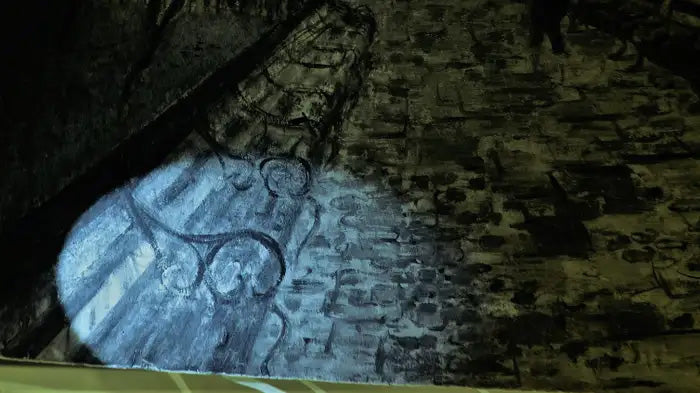
Carel Victor Morlais Weight R.A. , CH , CBE , 1908 - 1997, was an English painter and art teacher. Carel Weight studied at Goldsmiths College and the Hammersmith School of Art , thereafter he taught art at the Beckenham School and the Royal Academy of Art. He exhibited at the Cooling Galleries, the Royal Academy and many other institutions, he was a prolific painter of suburban scenes having been born in Paddington London and living in Hammersmith, as a very accomplished artist his works are well dispersed among the major galleries throughout the United Kingdom and in private collections . He was an official war artist during WW11 and consequently he travelled extensively, he was a good friend of other popular artists some of whom remained great friends throughout his life such as Ruskin Spear. This painting is we believe the Queens Park Bridge Chester, originally built in 1852, images of bridges Carel Weight painted are also included here. Carel Weight had a particular habit of painting bridges, railings and fences, within his compositions with a view as to the regular visitor overseeing the depiction, the artist is constantly putting himself in the place of someone watching over the scene, this picture is painted as if the viewer is walking along the pathway at a short distance from the person in front. Carel Weight produced many of his works with this theme of travelling in the same direction, looking over a fence, or looking out of a window, all of these themes are very typical of a suburban artist. This picture is unsigned. I have included a short biography of the painter. Carel Victor Morlais Weight (10 September 1908 – 13 August 1997) was an influential English painter and academic whose highly individual work captured the extraordinary, and often sinister, dramas lurking beneath ordinary suburban British life. Melding elements of realism with unexpected, distorted perspectives, Weight focused his career on expressing raw psychological states like fear, loneliness, and love within familiar urban landscapes. He is also widely celebrated as a transformative Professor of Painting at the Royal College of Art, where he nurtured some of the most notable figures of the Pop Art movement. Born in Paddington, London, Weight grew up experiencing stark social contrasts. Because both of his parents worked, he spent weekdays in a working-class Fulham home with his godmother, Rose Matkin, and returned to his parents' more affluent, middle-class household on weekends. This childhood duality made him hyper-aware of social divisions and the fragility of everyday life. Early memories of sudden shocks—such as a bus mounting a pavement or buildings burning—later became the emotional catalyst for his narrative-driven artwork. Weight initially studied singing before pivoting to the visual arts. He attended the Hammersmith School of Art from 1928 to 1930, where he established a lifelong friendship with fellow artist Ruskin Spear. He then advanced to Goldsmiths' College (1931–1933). While there, he focused heavily on imaginative composition, establishing a foundation for his distinct style. During the Second World War, Weight was called up to the Royal Engineers in 1942. He initially taught within the Army Education Corps before receiving a major career breakthrough in 1945. At the recommendation of Kenneth Clark, the influential chairman of the War Artists' Advisory Committee, Weight was appointed an Official War Artist. He travelled through Italy, Austria, and Greece to document post-war recovery and British army education efforts. Weight later fondly referred to this period of international travel as a "scholarship from the Army. In 1947, Weight joined the faculty at the Royal College of Art (RCA) in London. He quickly rose through the academic ranks, eventually serving as the Professor of Painting from 1957 until his retirement in 1973. Though Weight himself maintained a relatively traditional, old-fashioned personal demeanour, he was an incredibly supportive and affectionate mentor to a radical new generation of artists. Under his leadership, future trend-setters such as David Hockney, Peter Blake, and John Bratby flourished. Notably, Weight jokingly boasted that he was the very first person at the RCA to witness David Hockney dye his hair blonde. Weight famously considered himself a "maverick" who disliked the commercial politics, dealers, and critics of the mainstream art world. His paintings are highly recognisable for their unique narrative tension. He set most of his imaginative scenes in the unassuming suburbs of West and South London, often commuting by bus between his home in Clapham and his studio in Putney to find inspiration. Weight famously declared that the "acid test" of any great painting was whether an "ordinary chap" could get something out of it. He intentionally rooted complex psychological emotions into real, digestible settings. His figures, which he claimed "grew under the brush," often look like ghosts or hurried passersby. This generated an atmospheric blend of humour, dread, and menacing suspense that commentators have compared to English gothic ghost stories. Later in his career, he developed a deep interest in religious imagery, creating massive public works such as the Christ and the People mural for Manchester Cathedral in 1963. Throughout his life, Weight was highly celebrated across major British art institutions. He was elected a full Royal Academician (RA) in 1965 and was granted a massive career retrospective at the Royal Academy of Arts in 1982. He was appointed a Commander of the Order of the British Empire (CBE) in 1962 and later elevated to a Companion of Honour (CH) in 1995.In 1990, after living together for 60 years, Weight married his lifelong partner and fellow painter, Helen Roeder. He remained remarkably prolific into his old age, often executing up to 50 paintings a year. Weight passed away following a stroke on 13 August 1997 in London at the age of 88. Today, his masterpieces are preserved in premier global institutions, including the Tate Gallery, the Victoria and Albert Museum, and the Imperial War Museum. His art also captured the attention of private cultural icons, including David Bowie, who avidly collected his work.