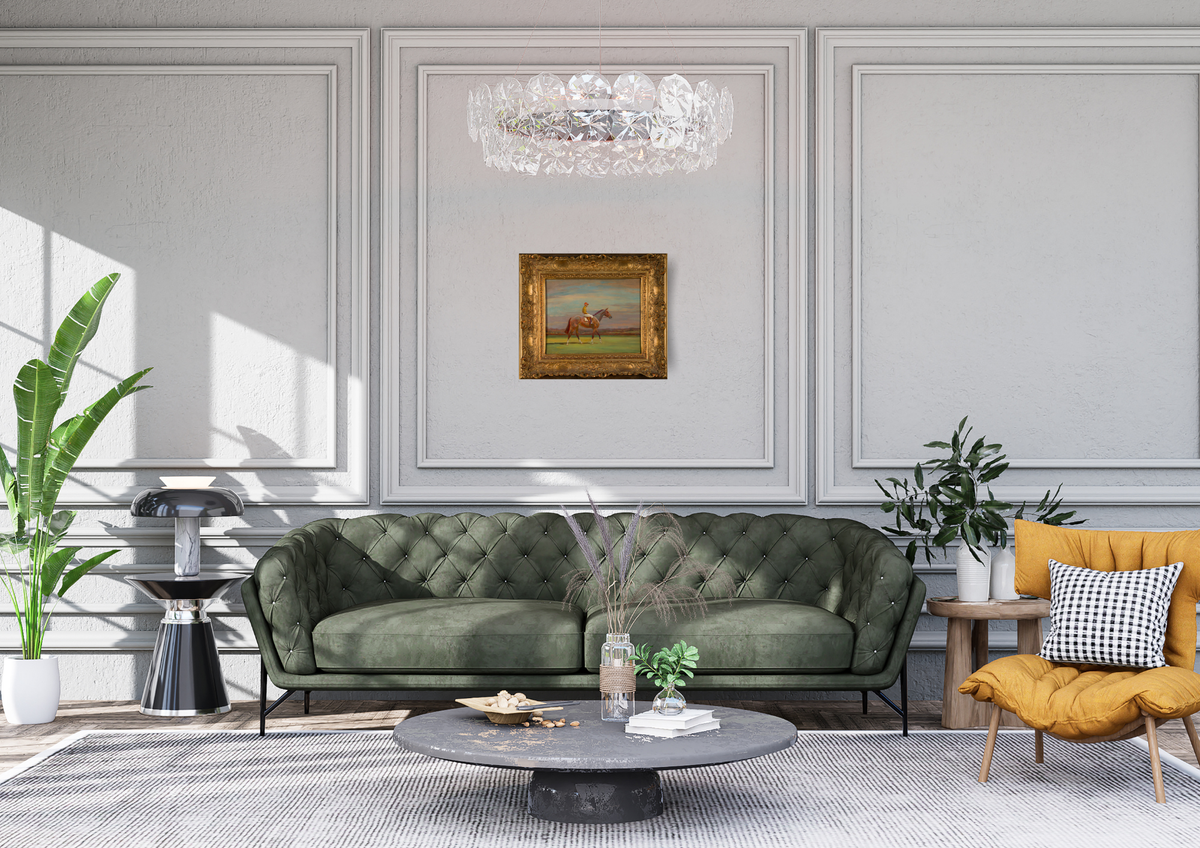
Circle of Sir Alfred Munnings
Jockey Up Riding in The Duke of Richmond's Colours
Jockey Up Riding in The Duke of Richmond's Colours
Couldn't load pickup availability
 Date Created Early 20th Century
 Size with Frame Height: 20 in (50.8 cm)Width: 24 in (60.96 cm)Depth: 3 in (7.62 cm)


Circle of Sir Alfred Munnings, 1878 - 1959. Munnings was an English born painter, draughtsman and illustrator of predominantly, horses, mostly race horses. He was probably the finest painter of horses and he became the President of the Royal Academy of Arts, he was a critic of the modern arts movement and opposed their works vociferously. He was a most prolific painter and famous throughout the UK and it would be a disservice to the painter for me to attempt a worthy biography here so I have included a scholarly shortened version for your interest, listed below. We have listed the painting as unsigned, however, the painting does appear to have remnants of a mark, under painting lower left, Infra red and UV images enclosed, which looks to have been made with a stylus, albeit found under the original brushwork, and as there is evidence that Munnings used a stylus within certain areas of a painting for enhancement we are listing the work as 'circle of' we therefore would have preferred to attribute this painting to the artist, despite the lack of formal identification and no visual signature on the immediate surface. The horse and rider is unidentified. We have asked Whetherbys to look into the painting of the horse and rider for our records, and according to their records the rider is known to be wearing the Duke of Richmond's colours and it is further known that Munnings frequently painted at Goodwood and knew the successive Dukes of Richmond well. In 1928 the 7th Duke of Richmond, Charles Henry Gordon- Lennox died and his heir the 8th Duke was unfortunately subjected to financial demands almost certainly due to Death Duties sustained, and a proportion of the contents of Goodwood were removed for outstanding payments , although in an attempt by our researchers to gain further information regarding any known knowledge of the horse and rider and after writing to the archive manager of Goodwood no reply was forthcoming. However speculation of the history of this painting is interesting and further investigation is advised, especially where some of the Goodwood Estate and contents were displaced and relinquished to pay the inheritance tax. This particular unpopular tax caused many difficulties for the 8th and 9th Dukes in the 1920's and 1930's, culminating in the loss of the Gordon Estate in Scotland, however Goodwood was retained and is now an extremely successful enterprise with the current 11th Duke. Alternative biography:- Sir Alfred Munnings (1878–1959) was one of the most celebrated equine and sporting artists of the 20th century. Born in Suffolk, he rose from a commercial poster designer to become the President of the Royal Academy (1944–1949). His work is defined by a brilliant mastery of light, a loose "impressionistic" brushstroke, and an unparalleled understanding of the horse’s anatomy and spirit. Munnings’ style bridged the gap between traditional British sporting art and modernism. Unlike his predecessors, who often painted stiff, anatomical "portraits" of horses, Munnings captured motion, the play of sunlight on a horse’s coat, and the social atmosphere of the racetrack. His fame grew during WWI as an official war artist with the Canadian Cavalry Brigade, where his sketches of horses in combat solidified his reputation as the premier painter of the "working" animal. The relationship between Munnings and the Goodwood Estate is centered on the Duke of Richmond’s patronage and the estate's status as a pinnacle of British horse racing. He commissioned Munnings to paint several scenes of the Goodwood racecourse. "The Paddock at Goodwood": One of Munnings’ most famous compositions, The Paddock at Goodwood, captures the unique atmosphere of the "Glorious Goodwood" meeting. It highlights the estate’s distinct landscape—specifically the backdrop of the Sussex Downs—which Munnings found visually superior to the flat terrains of Newmarket. Munnings’ paintings at Goodwood did more than capture horses; they documented the changing social hierarchy of the 1920s and 30s. He often included members of the Richmond family and the elite racing crowd, set against the rolling hills of the estate. To this day, the Duke of Richmond’s private collection at Goodwood House includes significant works by Munnings. These are often displayed alongside the 18th-century masterpieces of George Stubbs, illustrating the estate's continuous history as a patron of the finest equine art. Munnings is also remembered for his staunch, often vocal, opposition to Modernism. In his 1949 RA retirement speech, he famously attacked the works of Picasso and Matisse, and a further dislike of the sculpture of Henry Moore. Despite this traditionalist stance, his technical skill ensures his work remains highly sought after; his paintings of Goodwood scenes frequently command multi-million pound prices at auction.