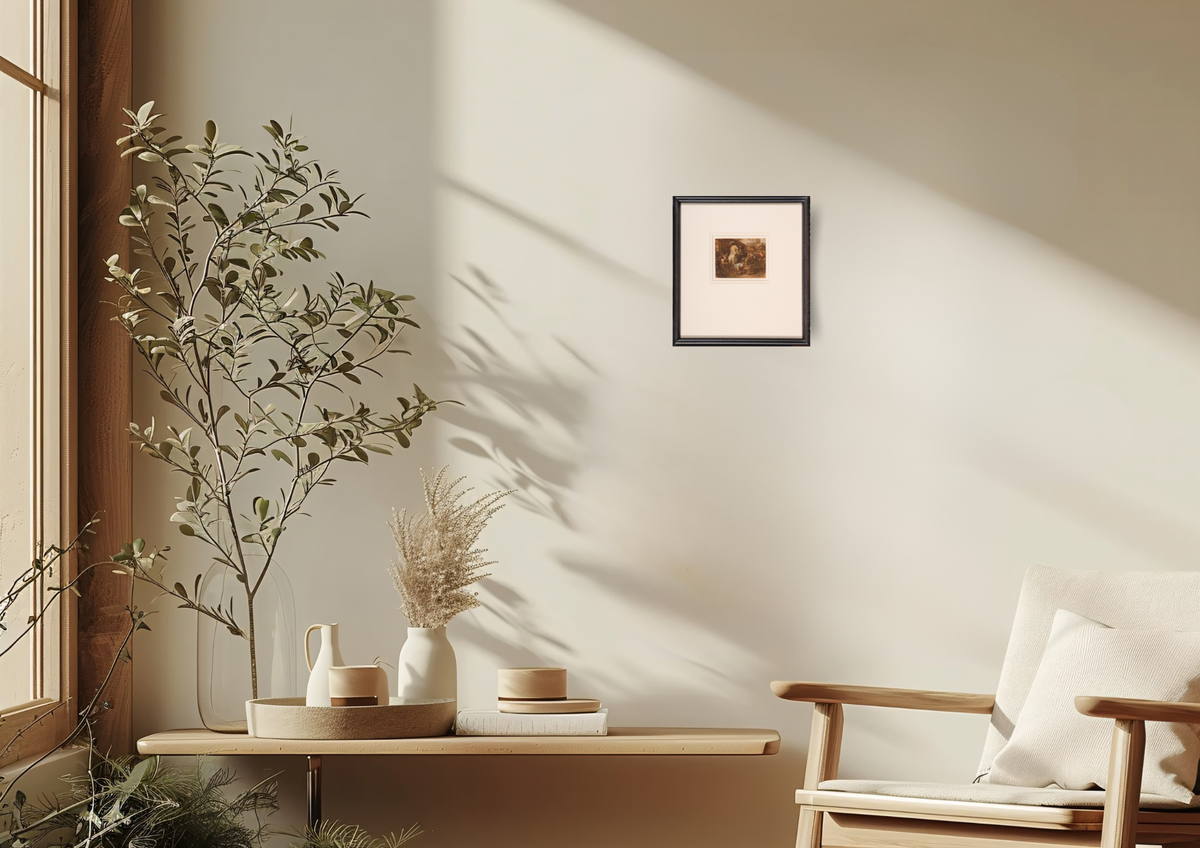
Gerrit Dou (manner of)
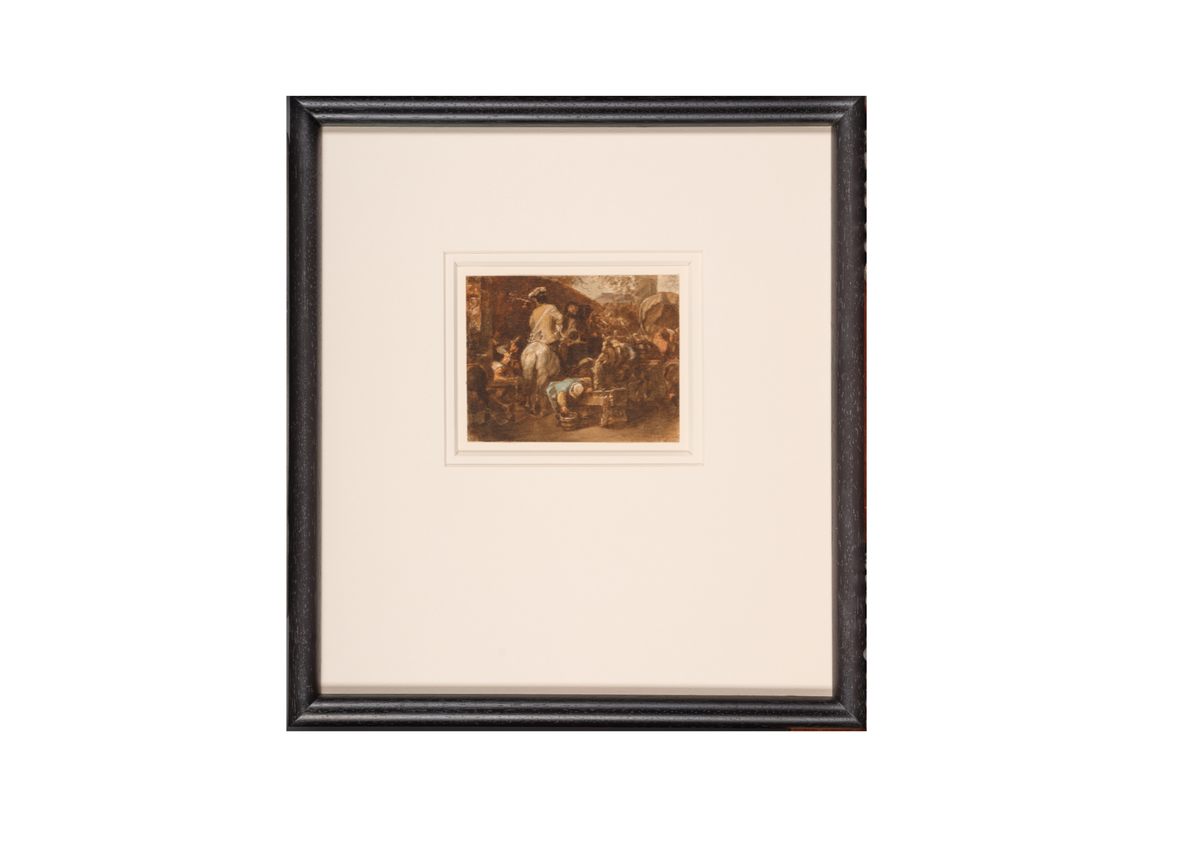
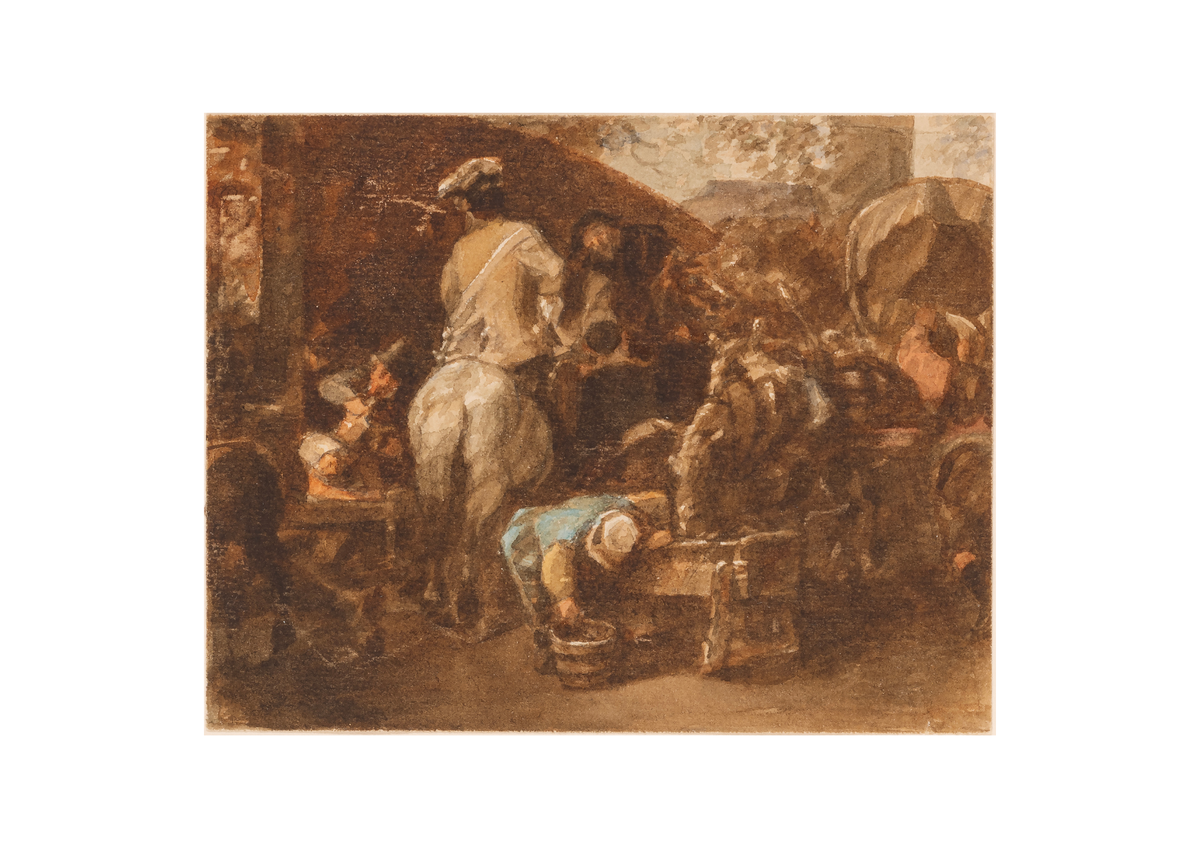
Dutch Officer with Companion at a Wayside Tavern
Dutch Officer with Companion at a Wayside Tavern
 Date Created Late 18th Century to early 19th Century
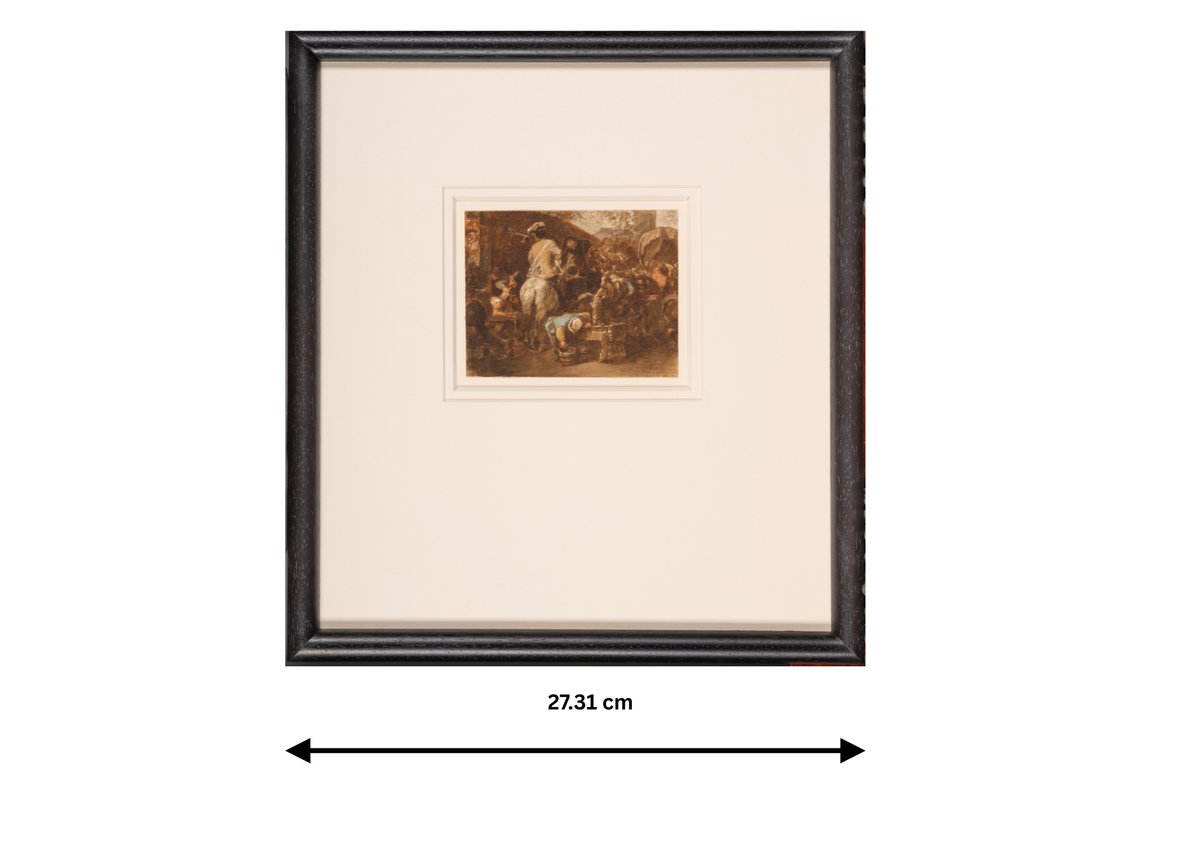
 Size with Frame


This small high quality watercolor has caused something of a mystery for sometime, we have decided to catalogue the picture as in the manner of Gerrit Dou, or Adriaen Van Ostade as we believe it is a Dutch tavern scene where the rider and his companion are in the position of taking their refreshment before the continuation of their journey the picture has been subjected to infra red, UV, visual and light box imaging, all of which identify the areas that contain information relating to the painter, which has evaded us, the picture is unsigned , it might be relevant to this being a preparatory study to an oil on panel and the reason for being unsigned. The picture is very similar to a work by Adriaen Van Ostade, however the size of the is considerably smaller here than the painting itself, but the theme is the same. The picture is unsigned but there is evidence of initials and script of the artist. The picture is believed to date from the late 18th Century to the early 19th Century.
Gerrit Dou (7 April 1613 – buried 9 February 1675) was a highly influential Dutch Golden Age painter and the foundational figure of the fijnschilder (fine painter) style. Renowned for his small-scale, meticulously detailed domestic interiors and striking candlelit genre scenes, Dou was so highly esteemed during his lifetime that his paintings frequently commanded prices far exceeding those of his legendary master, Rembrandt van Rijn.
Born in Leiden to a stained-glass maker and manufacturer, Dou began his artistic trajectory under his father's guidance. He initially trained in drawing with Bartholomeus Dolendo and studied glass-painting under Pieter Couwenhorn. However, his career path shifted drastically in February 1628 when his father sent the 14-year-old Dou to study under a 21-year-old Rembrandt.
As Rembrandt’s first official pupil, Dou spent three years in his workshop. He deeply absorbed his master's dramatic handling of colour and chiaroscuro (light and shadow). When Rembrandt relocated to Amsterdam in 1631, Dou chose to stay in Leiden, establishing himself as an independent master painter.
Rather than mimicking Rembrandt’s increasingly loose, expressive brushwork, Dou went in the opposite direction. He pioneered the Leiden school of fijnschilders, crafting miniature, jewel-like paintings with an almost enamelled, hyper-smooth surface finish.
Dou was notoriously fastidious about his work environment. He had an absolute horror of dust—often waiting for airborne particles to settle before opening his paints—and custom-crafted his own micro-brushes. To achieve his legendary precision, he often painted using a magnifying glass.
He became celebrated for specific visual motifs:
- Trompe-l’œil "Niche" Paintings: Scenes framed by arched stone windows or heavy, drawn curtains that made the subjects appear as if they were stepping into the viewer's physical space.
- Chiaroscuro Night-Scenes: Intimate settings, like The Evening School, illuminated exclusively by flickering candles or lanterns.
- Symbolic Genre Art: Meticulous domestic tasks, medical consultations, or depictions of hermits filled with subtle allegories on mortality, frugality, and contemporary Dutch proverbs.
In 1648, Dou co-founded the Leiden Guild of St. Luke alongside Jan Steen, anchoring the city as a major artistic hub. He was also an acclaimed teacher, mentoring monumental artists like Frans van Mieris the Elder and Gabriël Metsu.
Dou's commercial success was extraordinary. Wealthy international patrons—including Cosimo III de' Medici and Archduke Leopold Wilhelm of Austria—vied for his work, with individual pieces occasionally selling for the price of a house. In 1665, he became the first artist recorded to have a solo exhibition during his own lifetime.
When Dou died in 1675, he left behind a massive estate valued at approximately 20,000 guilders. While his obsession with hyper-neatness and precision fell out of favour in the mid-19th century with the dawn of Impressionism, a modern art revival since the 1970s has firmly restored his legacy as a master craftsman of the Dutch Baroque era.
Adriaen van Ostade (baptized 10 December 1610, Haarlem – buried 2 May 1685, Haarlem) was a preeminent Dutch Golden Age painter, printmaker, and draughtsman who stands as one of the most prolific and influential chroniclers of seventeenth-century rural and lower-class life. Operating out of the artistic hub of Haarlem, Van Ostade shaped the trajectory of northern genre painting, transitioning the raw, satirical depictions of peasant life into nuanced, atmospheric explorations of domestic and community structures.
Born to Jan Hendricx van Eyndhoven, a linen weaver, and Janneke Hendriksdr, Adriaen was the third of eight children. While primary archival records regarding his formal apprenticeship are lost, the foundational eighteenth-century painter-biographer Arnold Houbraken asserts that Van Ostade studied under the renowned portraitist Frans Hals around 1626–1627. According to Houbraken, he shared this training alongside the Flemish master of low-life genre painting, Adriaen Brouwer.
Van Ostade’s artistic output is conventionally divided into distinct stylistic phases that mirror the broader socio-economic and cultural shifts of the Dutch Republic:
- Early Phase (1630s): His earliest signed works, such as the 1633 "Peasants Playing Cards", demonstrate a profound stylistic debt to Adriaen Brouwer. These compositions are populated by unidealised, dynamic figures engaged in rowdy debauchery, brawling, and carousing inside dark, chaotic taverns or dilapidated barns. His brushwork during this era was energetic, fluid, and applied to a restricted, monochromatic palette of earthy browns, greys, and muted greens.
- Middle Phase (1640s): Around 1640, Van Ostade integrated the dramatic chiaroscuro of Rembrandt van Rijn into his work. He began employing more sophisticated light-and-shade dynamics to structure interior spaces, giving his crowded peasant quarters a heightened sense of architectural depth, three-dimensional volume, and dramatic focus.
- Mature Phase (Post-1650): Following the mid-century mark, Van Ostade’s work underwent a noticeable transformation. Reflecting the growing prosperity of the Dutch Republic, his rustic subjects adopted refined manners, and their surrounding domestic or tavern interiors became tidier, calmer, and more structurally ordered. Concurrently, his palette brightened significantly, incorporating richer, varied colours and lighter tonal keys that enhanced the idyllic, poetic quality of ordinary rural activities.
Van Ostade was fully integrated into the civic and administrative fabric of Haarlem. He entered the Haarlem Guild of Saint Luke by 1632 and actively directed its governance later in life, serving as warden (hoofdman) in 1647 and 1661, and as dean (deken) from 1662 to 1663. In 1636, he also served in the Oude Schuts civic guard company.
His personal life brought considerable financial stability. Following his first marriage to Macheltje Pietersdr (who died in 1642), he married Anna Ingels in 1657—a wealthy Catholic woman from Amsterdam—at which point he appears to have converted to Catholicism. Substantial inheritances from his second wife and her father, coupled with a highly lucrative artistic output, elevated Van Ostade to a wealthy burgher status. By 1670, he resided in a prestigious home on Haarlem's Ridderstraat. During the Year of Disaster (Rampjaar) in 1672, the French invasion prompted a brief flight to Amsterdam, though he soon returned to Haarlem.
Van Ostade’s staggering artistic legacy includes more than 800 attributed oil paintings (mostly executed on small-scale wood panels), approximately 50 intricate etchings, and numerous watercolours and pen drawings. Beyond his solo output, he frequently collaborated with other prominent landscape and architectural painters—such as Pieter Saenredam and Jacob van Ruisdael—by painting staffage (human figures) into their scenes.
As a master of a large and active workshop, his pedagogical influence extended across generations. His most notable pupils included his short-lived younger brother Isaack van Ostade, Cornelis Bega, Cornelis Dusart, Michiel van Musscher, and the legendary master of chaotic domestic genre painting, Jan Steen. Adriaen van Ostade died in April 1685, just six days after witnessing his daughter's wedding, leaving behind a legacy that transformed the raw imagery of seventeenth-century rural society into highly sought-after, masterfully illuminated high art.